
For the first youth production of the
2017-2018 season, The NOVA Center for the Performing Arts
presented "Brundibar: A Youth Opera," an inspiring story
about perseverance and triumph. The play runs Sept. 30
through Oct. 15.
In "Brundibar," Aninka (Annette, in
English) and Pepicek (Little Joe) are a fatherless sister and
brother. Their mother is ill, and the doctor tells them she
needs milk to recover. But they have no money. They decide to
sing in the marketplace to raise the needed money. But the evil
organ grinder Brundibar (who represents Hitler) chases them
away.
With the help of a fearless sparrow, a
keen cat, a wise dog and the children of the town, they are
able to chase Brundibar away, and sing in the market square.
The opera contains symbolism in the
triumph of the helpless and needy children over the tyrannical
organ grinder, but has no overt references to the conditions
under which it was written and performed. However, certain
phrases were to the Jewish audience clearly anti-Nazi.
"Brundibar" was first suggested to the
Rimrock Opera Foundation in 2005 by Douglas Nagel and has been
in discussion since then. NOVA past-president Lucinda Butler
has promoted this children’s opera, considering recent events
in the U.S. dealing with race relations and neo-Nazi activity.
NOVA believed that now was an appropriate time to produce this
show.
In 1938, composer Hans Krasa and
librettist Adolf Hoffmeister wrote "Brundibar" in the ghettos
of Prague. The opera made its way to the Jewish camp of
Terezin, where it was performed 55 times by the children of the
concentration camp under the direction of Jewish music
teachers.
The only time the children were allowed
to remove their yellow stars from their clothing was during
these performances. The Nazi command permitted concerts at
Terezin in order to delude the outside world into thinking the
Jews were being treated humanely. A special performance of
"Brundibar" was staged in 1944 for representatives of the Red
Cross who came to inspect living conditions in the camp.
The Red Cross did not know at the time
that much of what they saw during their visit was a sham, and
that one of the reasons the Terezin camp seemed comfortable was
that many of the residents had been deported to Auschwitz in
order to reduce crowding during their visit.
In 1944, the Nazis filmed a performance
of "Brundibar" for their propaganda film, "The Fuehrer Presents
the Jews with a City." Nearly all of the participants in this
Terezin production were herded into cattle trucks and sent to
Auschwitz as soon as filming was finished. Most were gassed
immediately upon arrival, including the children, the director
Kurt Gerron, and the musicians. Krasa met the same fate.
In Terezin, Krása had reconstructed the
full score of the opera, based on memory and the partial piano
score that remained in his hands, adapting it to suit the
musical instruments available in the camp, which included
flute, clarinet and guitar.
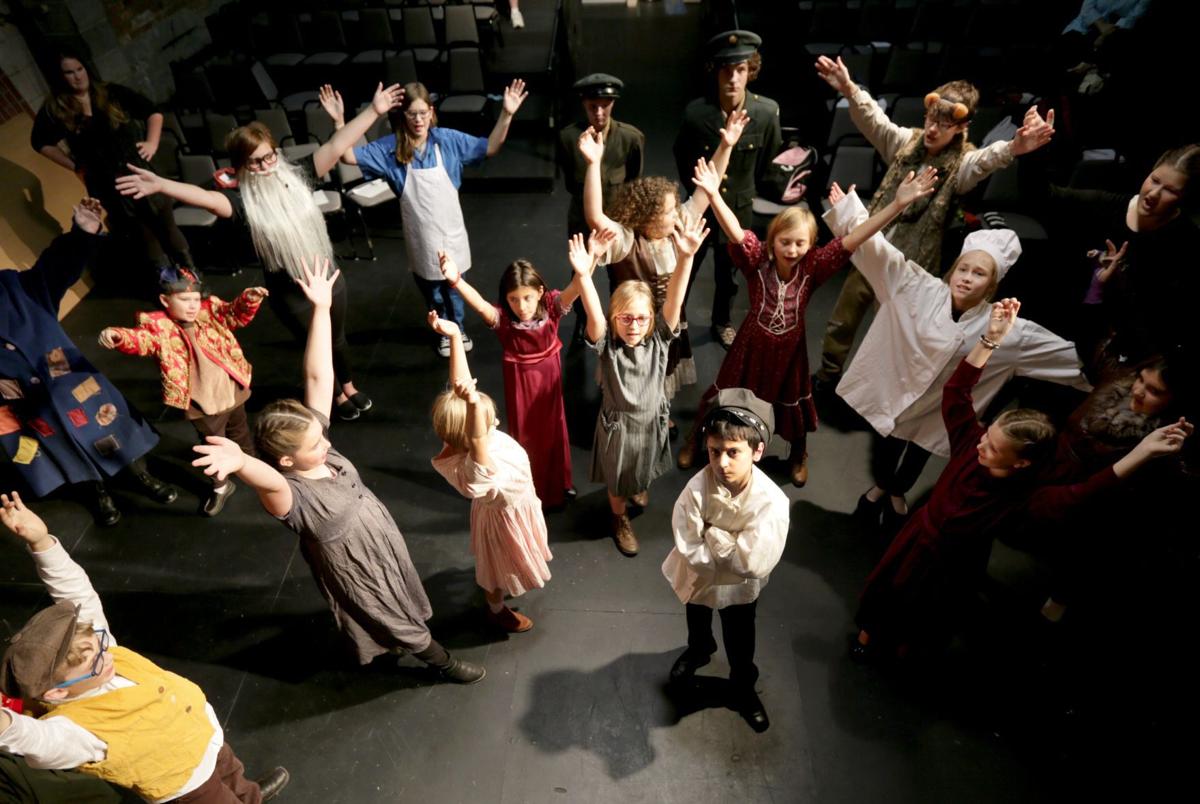
Kids of all ages perform a scene
during a rehearsal for "Brundibar: A Youth Opera" at the NOVA
Center for the Performing Arts. An opera with a remarkable and
heartbreaking origin and history during the WWII era,
"Brundibar" the first of the NOVA's youth productions this
season.
BRONTE WITTPENN, Gazette staff


